Coulomb’s Law.
If two stationary and point charges 


or repulsion between them is 

(1) Dependence of k :
Constant k depends upon system of units and medium between the two charges.
(i) Effect of units
(a) In C.G.S. for air 

(b) In S.I. for air 

Dyne)
Note :
Absolute permittivity of air or free space =
. It’s Dimension is
Relates with absolute magnetic permeability (
) and velocity of light (c) according to the following relation

![\displaystyle [M{{L}^{-3}}{{T}^{4}}{{A}^{2}}]](https://s0.wp.com/latex.php?latex=%5Cdisplaystyle+%5BM%7B%7BL%7D%5E%7B-3%7D%7D%7B%7BT%7D%5E%7B4%7D%7D%7B%7BA%7D%5E%7B2%7D%7D%5D&bg=ffffff&fg=000&s=0&c=20201002)

(ii) Effect of medium
(a) When a dielectric medium is completely filled in between charges rearrangement of the charges inside the dielectric medium takes place and the force between the same two charges decreases by a factor of K known as dielectric constant or specific inductive capacity (SIC) of the medium, K is also called relative permittivity er of the medium (relative means with respect to free space).
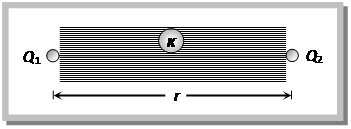
Hence in the presence of medium 
Here 
(b) If a dielectric medium (dielectric constant K, thickness t) is partially filled between the charges then effective air separation between the charges becomes 

Hence force 
(2) Vector form of coulomb’s law :
Vector form of Coulomb’s law is

where 
(3) A comparative study of fundamental forces of nature
|
S.No. |
Force |
Nature and formula |
Range |
Relative strength |
|
(i) |
Force of gravitation between two masses |
Attractive F = Gm1m2/r2, obey’s Newton’s third law of motion, it’s a conservative force |
Long range (between planets and between electron and proton) |
1 |
|
(ii) |
Electromagnetic force (for stationary and moving charges) |
Attractive as well as repulsive, obey’s Newton’s third law of motion, it’s a conservative force |
Long (upto few kelometers) |
|
|
(iii) |
Nuclear force (between nucleons) |
Exact expression is not known till date. However in some cases empirical formula |
Short (of the order of nuclear size 10–15 |
1039 (strongest) |
|
(iv) |
Weak force (for processes like b decay) |
Formula not known |
Short (upto 10–15m) |
1024 |

 can be utilized for nuclear potential energy
  and
and  are constant.
Note :
- Coulombs law is not valid for moving charges because moving charges produces magnetic field also.
- Coulombs law is valid at a distance greater than
- A charge
exert some force on a second charge
. If third charge
is brought near, the force of
- Ratio of gravitational force and electrostatic force between (i) Two electrons is 10–43/1. (ii) Two protons is 10–36/1 (iii) One proton and one electron 10–39/1.
- Decreasing order to fundamental forces


(4) Principle of superposition :
According to the principle of super position, total force acting on a given charge due to number of charges is the vector sum of the individual forces acting on that charge due to all the charges.

Consider number of charge
Net force on Q will be
